
Zebra RS2100 Scanner Guide: Full Specs, Benefits & Use Cases for Hands-Free Scanning
Posted by Midwest Barcoding Solutions on Nov 13th 2025
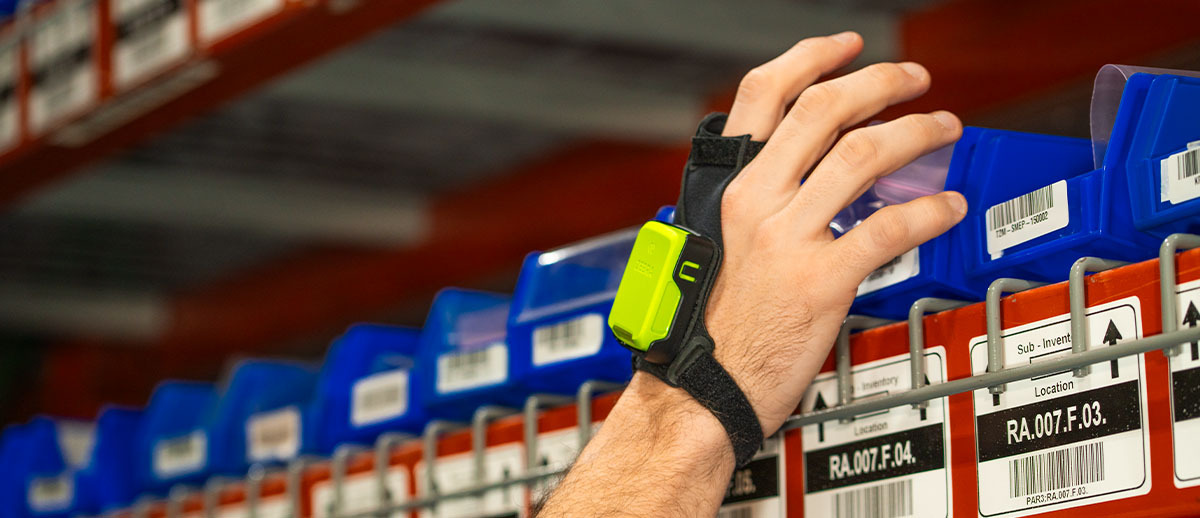
For decades, the pistol-grip barcode scanner has served as the backbone of data capture across warehouses, distribution centers, manufacturing plants, and retail environments. These scanners are reliable and widely used, but they also interrupt workflow. Every scan requires a worker to pick up a device, aim it, activate the trigger, and then place it back down. These small repetitive motions accumulate throughout a shift, creating inefficiencies, wasted time, and additional fatigue.
The Zebra RS2100 back-of-hand wearable scanner rethinks this model from the ground up. Instead of forcing the worker to adapt to the scanner, the RS2100 adapts to the worker. It is worn on the back of the hand—lightweight, unobtrusive, and always ready to scan without requiring the worker to grip a device. For fast-paced operations where both hands are constantly engaged, the RS2100 allows barcode scanning to blend into the natural flow of movement, delivering measurable improvements in productivity and ergonomics.
A Unique Form Factor With a Clear Purpose
The RS2100’s mission is simple: remove friction from barcode scanning by eliminating the need to pick up a device. The back-of-hand design keeps the palm free, maintains full dexterity, and removes the need for constant transitions between handling product and holding a scanner. Workers can grab, lift, pick, assemble, or pack while the scanner remains securely attached—ready to capture barcodes the instant the hand moves into scanning position.
This form factor is especially valuable in workflows that rely on rapid, repetitive, or continuous scanning. Workers no longer divide their attention between handling items and operating a separate device. Instead, the scanner becomes part of the workflow, reducing cognitive load and improving scanning rhythm. Zebra intentionally engineered the RS2100 to be small, light and low-profile, minimizing interference in tight spaces such as pick bins, conveyor stations, and assembly lines.
Verified Performance Features and Capabilities
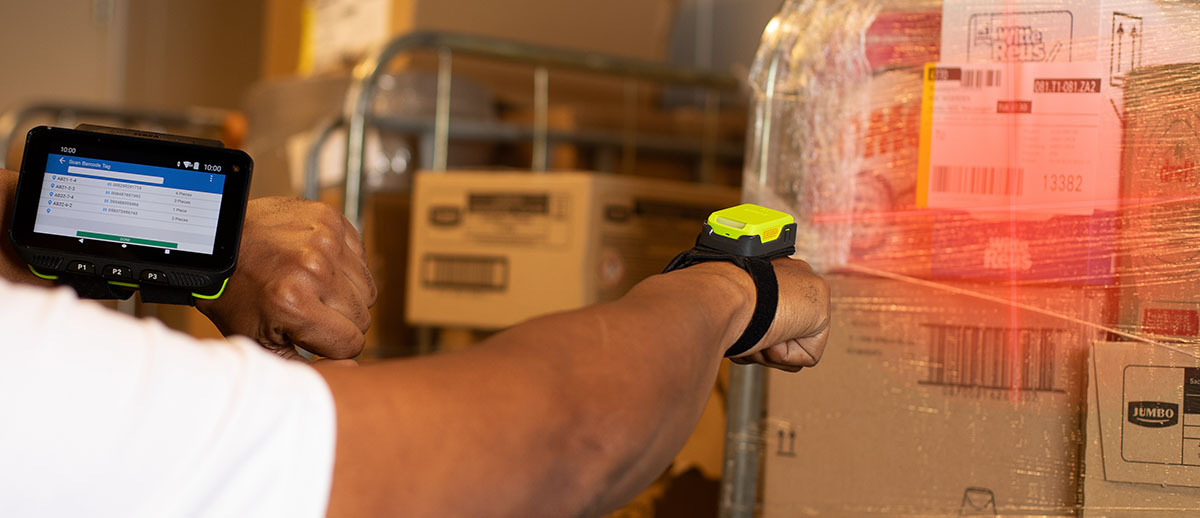
Zebra built the RS2100 on a technology foundation that supports both performance and endurance. It uses the SE4770 1D/2D imager, one of Zebra’s proven enterprise-grade scan engines, capable of decoding a full range of linear and two-dimensional symbologies—including DataMatrix, PDF417, QR Code, Micro QR, and standard retail UPC/EAN. Its imaging sensor (1280 × 800 pixels) allows it to read damaged, smudged, low-contrast, or curved barcodes that might challenge lesser scanners.
The working range officially supports near-contact scanning up to approximately 0.9 meters (36 inches), depending on barcode size, print quality, and lighting conditions. This range aligns well with the daily reality of warehouse picking, shelf scanning, and package handling workflows. Workers typically scan items at arm’s reach, and the RS2100 is tuned precisely for that use.
Connectivity is equally modern. The RS2100 uses Bluetooth Low Energy (BLE) for power-efficient wireless performance and supports fast, intuitive NFC tap-to-pair functionality for pairing with Zebra mobile computers, tablets, or host PCs. Zebra also supports configurations where up to seven RS2100 scanners can connect to a single non-mobile host PC using a certified USB Bluetooth adapter—useful for pack stations and shared workcells.
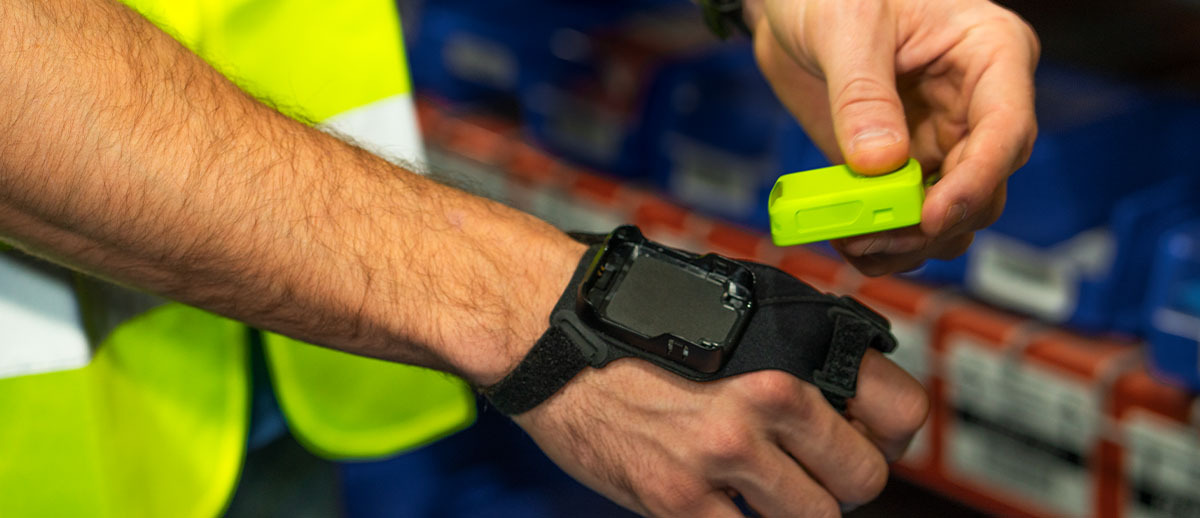
The device is engineered for durability with IP54 environmental sealing and a 1.8-meter (6-foot) drop specification to concrete. While rugged, it avoids the bulk of handheld scanners because it is less likely to be dropped while in use. The embedded battery is designed for full-shift operation, with Zebra providing published performance metrics of 18+ hours or approximately 17,000 scans per charge under typical usage conditions.
Real-World Ergonomics and Advantages
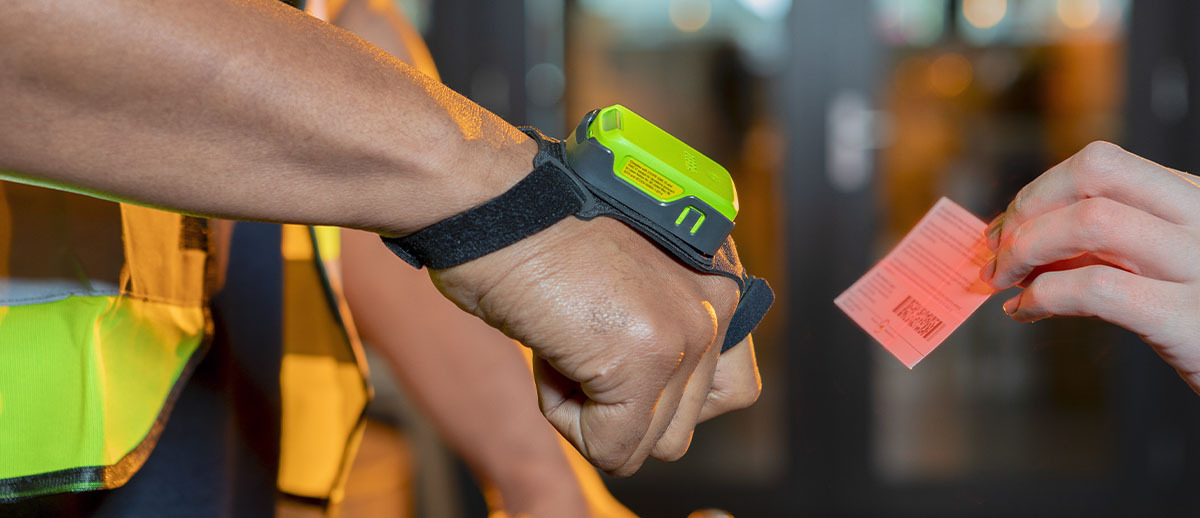
The greatest strength of the RS2100 is the way it transforms the worker experience. Instead of switching between handling inventory and operating a scanner, the worker performs both tasks simultaneously. The RS2100’s bare-palm design ensures that grasping, lifting, and manipulating items feel completely natural. Because the unit weighs only about 31 grams (1.1 ounces) and is just 14.6 mm thick, it does not feel cumbersome or awkward, even during long shifts.
In addition, wearable scanners dramatically reduce device drop incidents. While handheld scanners are frequently dropped—often resulting in repairs or failures—a wearable scanner remains attached during virtually all phases of operation. This can meaningfully reduce repair costs and downtime, improving return on investment and overall fleet reliability.
Total Cost of Ownership Compared to Traditional Scanners
Upfront cost is only one piece of the equation. The RS2100 often delivers better total cost of ownership (TCO) over time, especially in high-volume scanning environments.
Because scanning becomes a seamless part of movement, workflows accelerate and interruptions disappear. Zebra’s published materials describe potential productivity gains of up to 30% in certain picking and packing applications, though actual results will vary by operation. Even conservative improvements accumulate into meaningful labor savings across hundreds of hours of scanning activity each month.
Wearable scanners also reduce the repair and replacement burden. Traditional scanners can incur significant cost from drops, cracked housings, broken triggers, or damaged internal components. The RS2100’s wearable nature mitigates these failure modes. And because most wear occurs on the strap or mount rather than the device itself, ongoing maintenance costs tend to be lower and less disruptive.
Ideal Applications for the Zebra RS2100
The RS2100 is engineered for environments that require both agility and speed. It excels in workflows where workers must keep both hands free while scanning continuously or frequently throughout the day. These include warehouse picking, e-commerce fulfillment, replenishment, receiving, sortation, and retail inventory operations. It also integrates naturally into manufacturing processes where line-side scanning is required for component tracking, kitting, assembly, and quality control.
Parcel logistics is another strong use case, particularly in induction, routing, staging, and loading workflows where workers scan packages while constantly handling them. The RS2100 supports this type of motion-heavy work without slowing down the operator or forcing awkward transitions between tasks.
Is the RS2100 the Right Investment?
The RS2100 is a powerful solution for operations where scanning frequency is high and efficiency matters. It delivers ergonomic benefits, reduces wasted motion, and supports seamless workflow execution. For operations with continuous or repetitive scanning, wearable technology nearly always outperforms traditional handhelds in productivity and comfort.
However, it is not always the best fit for every environment. Workflows that require long-distance scanning, infrequent scans, or wide-area barcode capture may still warrant a more traditional handheld form factor. Matching the technology to the actual workflow remains essential to achieving the best return on investment.
Questions Businesses Should Ask Before Choosing the RS2100
While the RS2100 offers compelling advantages, an objective evaluation should consider:
- How frequently do workers scan? High-volume workflows benefit most from the hands-free model.
- What is the typical scanning distance? Work requiring long-range scanning may not align with the RS2100’s optimized range.
- Do workers need both hands available while scanning? If yes, the RS2100’s ergonomic design provides tangible gains.
- What is the history of device damage or downtime with current scanners? Organizations with heavy drop-related repair costs may benefit materially from a wearable device.
- Is the existing device ecosystem compatible with Bluetooth and NFC pairing workflows? Smooth integration is key to maximizing value.
These considerations ensure the RS2100 is deployed where it can deliver the greatest operational impact.
The Zebra RS2100 back-of-hand scanner represents a modern, worker-centric approach to data capture. With validated specifications, proven 1D/2D imaging performance, rugged durability, and a uniquely ergonomic wearable design, it brings measurable efficiency improvements to fast-paced industrial environments. For organizations seeking to reduce task friction, improve worker comfort, and boost throughput, the RS2100 offers a compelling and future-ready solution.
Talk to an Expert