
Lumber & Steel: The Rugged Guide to Asset Tracking in High-Impact Yards
Posted by Midwest Barcoding Solutions on Apr 8th 2026
By Midwest Barcoding Solutions | Asset Tracking | Outdoor Operations Guide
Standard warehouse barcode equipment fails in lumber and steel yards for predictable reasons. The drop specs that look impressive in a spec sheet were tested against a clean concrete floor, not a steel plate or a gravel surface with forklift traffic. IP ratings that pass water ingress tests don't account for sawdust accumulation in scanner housings or the vibration profile of a rough-terrain forklift. Labels that perform perfectly in a climate-controlled receiving bay peel off rough-sawn lumber or corrode on galvanized steel in a season.
The good news is that the right hardware handles all of this. The challenge is knowing which specifications actually matter for each environment — and which impressive-sounding numbers are irrelevant to your specific operation.
This guide covers both environments in detail: the specific failure modes, the hardware that addresses each one, and the label and scanning strategy that supports real asset tracking accuracy across a yard that might span acres, handle materials in any weather, and move product with forklifts and cranes that no handheld scanner was designed to be within arm's reach of.
The Lumber Yard — What Makes It Different
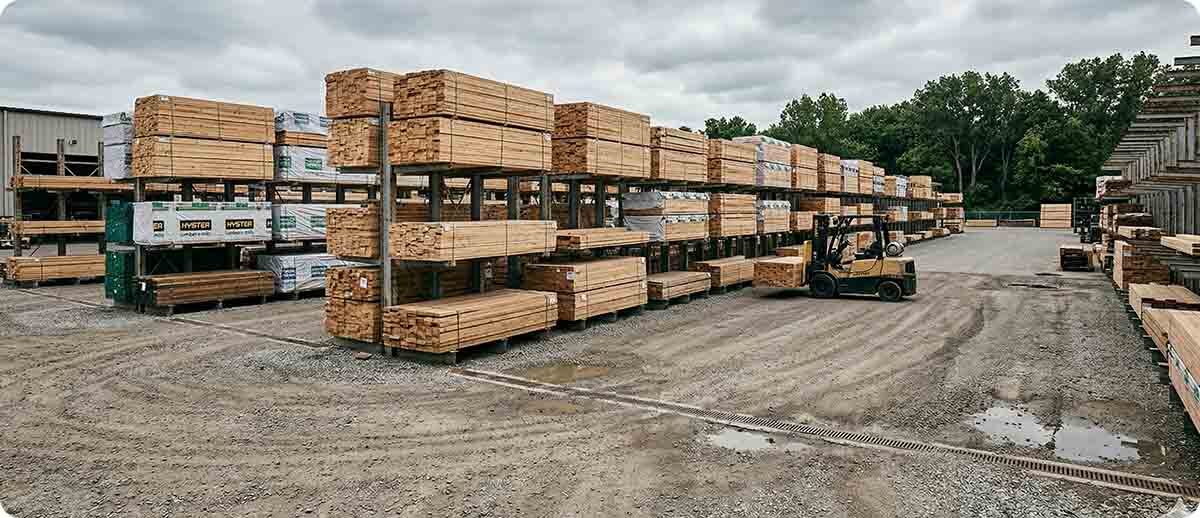
Lumber yards present a specific set of challenges that most barcoding vendors don't address directly because most of their customers operate in controlled indoor environments. If you're running a sawmill, dimensional lumber yard, timber framing operation, or wholesale building materials distributor, you're dealing with conditions that require a different approach on every level — from the label you put on the board to the device in the operator's hand to the computer mounted in the forklift cab.
The Lumber Yard Challenges:
Rough, inconsistent surfaces that reject standard adhesives. Rough-sawn lumber, pressure-treated timber, and green wood present surface conditions that defeat standard permanent acrylic adhesives. The moisture content of green or treated wood, combined with rough surface texture and resin migration, means a label that sticks perfectly in the first hour can be half-peeled by morning. Outdoor-rated polyester labels with enhanced adhesive formulations are required — and the adhesive specification matters as much as the facestock.
Sawdust — everywhere, always. Fine sawdust penetrates scanner housings through every gap and ventilation slot. It accumulates on scan windows and reduces read performance. It clogs charging cradle contacts and causes intermittent charging failures. In large volumes it can be a fire risk near heat-generating electronics. IP ratings for dust resistance (the first digit in an IP rating) matter more in a lumber yard than almost any other operating environment — and need to be verified as sustained operational ratings, not just lab test results.
Rain, snow, and full outdoor exposure. Dimensional lumber operations typically store significant inventory outdoors on pallet racks or in open sheds. Scanning operations happen in rain, snow, and direct sun. Devices need genuine outdoor operational capability — not just a splash resistance rating that covers running indoors near a loading dock.
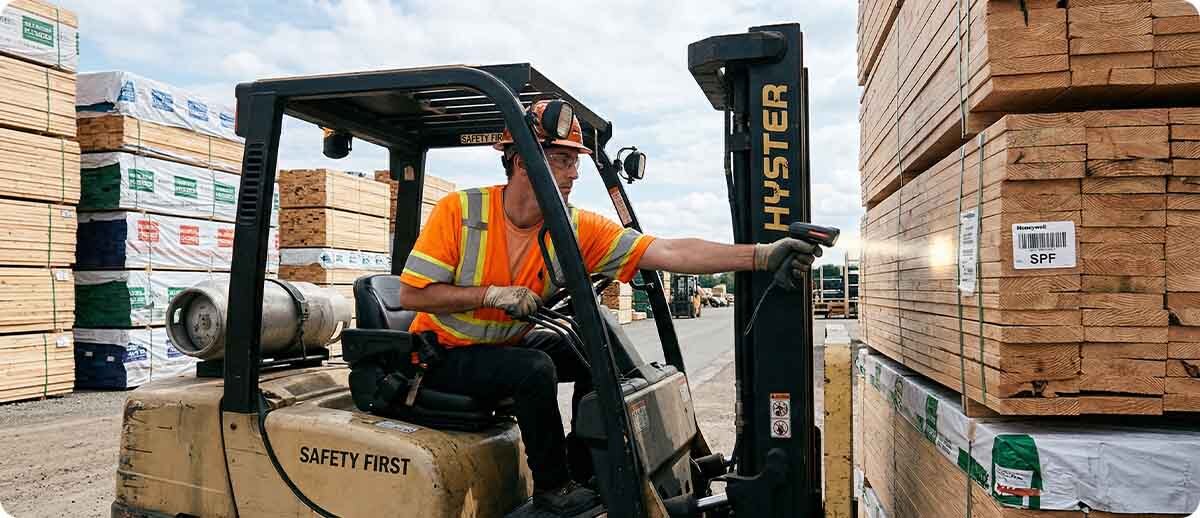
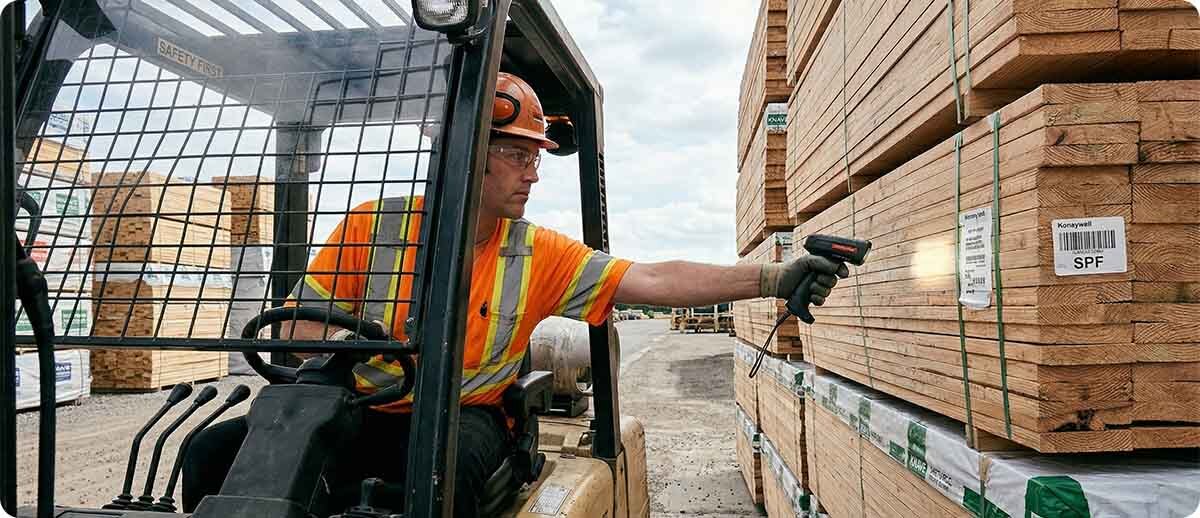
Long scanning distances from forklift operators. A forklift operator needs to scan a barcode on a bundle of lumber on the top rack of an outdoor storage structure — potentially 20, 30, or 40 feet away, in direct sunlight, from the cab of a moving vehicle. A standard warehouse scanner with a 5-foot read range and a red LED aimer that disappears in daylight is completely useless in this scenario. Extended range scanners with high-visibility aimers designed for outdoor use are the only solution.
Gloved workers in cold weather. Lumber yard work happens year-round. Winter operations mean gloved workers who cannot operate capacitive touchscreens and need physical keys or glove-mode screens to interact with mobile computers without removing insulation.
The Steel Service Center — A Different Kind of Brutal
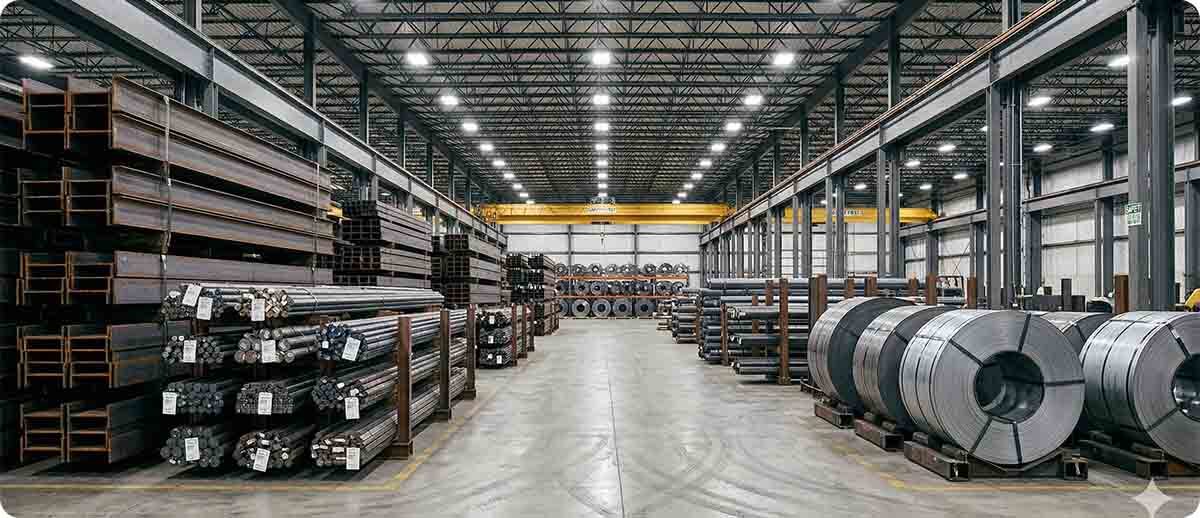
Steel service centers — operations that receive, cut, process, and distribute structural steel, plate, tube, pipe, bar, and sheet metal — operate in an environment that is categorically more hostile to barcoding hardware than almost anything in standard logistics. The combination of physical impact risk, metallic dust and oil contamination, high-contrast scanning requirements, and label adhesion challenges on metal surfaces creates a uniquely demanding problem set.
The Steel Yard Challenges:
Metal surfaces that defeat standard label adhesives. Steel, aluminum, and galvanized surfaces are among the most difficult substrates for label adhesion. Mill oils and processing lubricants on metal surfaces prevent standard acrylic adhesives from wetting the surface. Galvanized steel has a micro-textured zinc coating that presents adhesion challenges different from bare steel. Painted or powder-coated steel introduces plasticizer migration risk that degrades adhesive bond over time. Labels on metal surfaces need aggressive adhesives specifically formulated for low-energy and oily surfaces — not the same adhesive that works on cardboard in a warehouse.
Metallic dust and machining debris. Cutting, sawing, and grinding steel generates fine metallic particles that are electrically conductive and abrasive. In scanner housings, conductive metallic dust can cause electrical shorts that a sealed IP rating helps prevent but cannot fully eliminate if the seal is compromised by repeated impact. On scan windows, metal swarf creates abrasion that degrades optical performance over time. Regular cleaning protocols and sealed device designs are both required.
Extreme impact and drop risks. In a steel service center, the question isn't whether a device will be dropped — it's what it will be dropped onto. A scanner dropped on a steel plate surface hits harder than the same drop on concrete. Steel coil and structural steel handling involves crane and overhead equipment, and devices working in proximity to these operations face impact and vibration loads that most drop test specifications don't simulate. The highest available drop ratings are the starting point, not the finishing line.
RF interference from metal structures and equipment. Large steel structures — building frames, racking systems, coil storage — reflect and absorb Wi-Fi signals in ways that create dead spots and connectivity challenges. Wireless network design matters more in an all-metal environment, and devices that work reliably at the edge of Wi-Fi coverage in a standard warehouse may drop connection entirely in a steel service center's storage aisles.
Long product identification challenges. Steel bar, structural shapes, and pipe are often identified with end markings or tags attached to bundle ties — not labels applied to flat surfaces. Reading these markings from a distance, at an angle, or through protective wrapping requires extended range scanning capability and robust decode algorithms that handle degraded or non-standard barcodes.
The Hardware Stack: Devices Built for Outdoor Yards
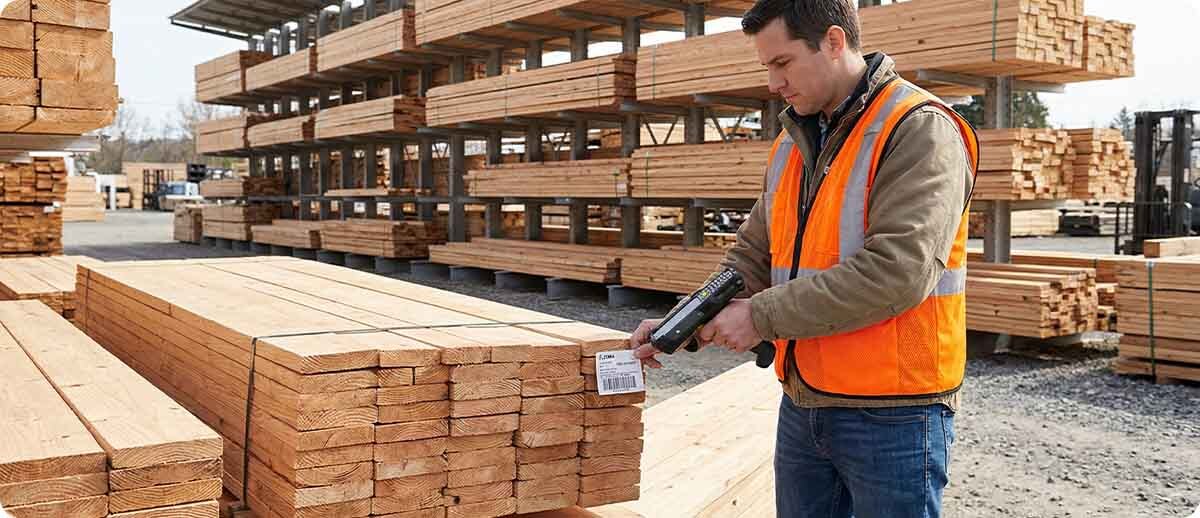
Midwest Barcoding Solutions stocks the full range of Zebra hardware purpose-built for outdoor yard asset tracking. Here is how each product category maps to the specific demands of lumber and steel operations.
Extended Range Cordless Scanning — For Operators Who Can't Get Close
Zebra DS3678-XR Ultra-Rugged Cordless Extended Range Scanner
Part #: DS3678-XR3U4212SVW (USB Kit) | DS3678-XR6F003VZWW (Scanner Only)
The DS3678-XR is the right answer to the most common yard scanning problem: the barcode is too far away. Scanning range from under 2 inches to over 105 feet with a green laser aimer that is 7x more visible than a standard red aiming dot — and visible in direct sunlight at distances up to 10 feet. In practical terms, a forklift operator can scan a bundle tag from inside the cab across a wide aisle or from ground level to the top tier of an outdoor rack. Drops from 10 feet to concrete. Dual IP65/IP68 sealing — fully submersible and completely sealed against sawdust and metallic particles. Over 80,000 scans per charge. Multi-code capture processes up to 20 barcodes simultaneously. PRZM Intelligent Imaging reads scratched, dirty, poorly printed, and wet barcodes. The benchmark extended range scanner for outdoor lumber and steel yard operations.
Shop the DS3678-XR →Zebra DS3678-SR Ultra-Rugged Cordless Standard Range Scanner
Part #: DS3678-SR3U4210SFW (USB Kit)
When scanning distances are under control — receiving stations, cut-to-length work areas, loading dock check-out — the DS3678-SR delivers the same ultra-rugged DS3600 series durability at a more accessible price point. 8-foot drop spec, IP67 sealing, 5-foot standard range, over 57,000 scans per charge. The SR is the right choice for yard office and covered receiving operations where the XR's extended range isn't needed but the ruggedness of the DS3600 platform is.
Shop the DS3678-SR →Vehicle Mount Computers — The Forklift Cab Command Center
Zebra VC8300 Ultra-Rugged Vehicle Mount Computer
Part #: VC83-08SOCQBAABANA (8" display) | VC83-10SSCNBAABANA (10" display)
The VC8300 is designed for exactly the environment a lumber or steel yard forklift operator works in. Ultra-rugged Android vehicle mount computer built to handle warehouse interiors, outdoor yards, loading docks, and freezer operations in a single device. The integrated full alphanumeric keyboard lets operators interact with WMS and inventory applications with gloves on — no touchscreen-only interaction that fails in cold weather or with work gloves. Available in 8-inch and 10-inch display configurations for varying forklift cab sizes. Runs legacy "green screen" terminal emulation apps out of the box for operations not yet on modern WMS platforms. The VC8300 paired with a DS3678-XR on a forklift cradle is the complete vehicle-mounted scanning solution for high-rack lumber and steel yard operations.
Shop the VC8300 →Rugged Mobile Computers — For On-Foot Yard Workers
Zebra MC9400 Ultra-Rugged Mobile Computer
Part #: MC9401-0G1M6ESS-NA (and variants)
For yard workers who are on foot — performing cycle counts, pulling cut orders from steel service center storage, conducting inventory audits across a lumber yard — the MC9400 is Zebra's ultra-rugged workhorse built for outdoor environments including yards and hazardous locations. Wi-Fi 6E for reliable connectivity even at the edge of network coverage in metal-heavy environments. Physical keypad for gloved operation. 6GB/128GB for demanding on-device applications. The MC9400 is fully backward compatible with all MC9300 accessories, making fleet upgrades straightforward for operations already running MC9300 devices. The go-to rugged handheld for high-demand outdoor yard inventory work.
Shop the MC9400 →Zebra ET60 Rugged Tablet
Part #: ET60WW-0S7EPSJ0A0-00 (and variants)
For yard supervisors and receiving managers who need a larger screen — reviewing incoming steel orders, managing cut lists for a day's production, or running a full WMS dashboard from a forklift cab or outdoor office — the ET60 rugged Windows tablet delivers enterprise computing in a format built for demanding environments. Resists dust, drops, and moisture across manufacturing floors, field service, and outdoor yard operations. Can be vehicle-mounted via compatible mounting systems. Pairs with Zebra peripherals for barcode scanning when needed. Right for roles where a phone-sized device isn't enough screen real estate but a laptop isn't durable enough.
Shop the ET60 Rugged Tablet →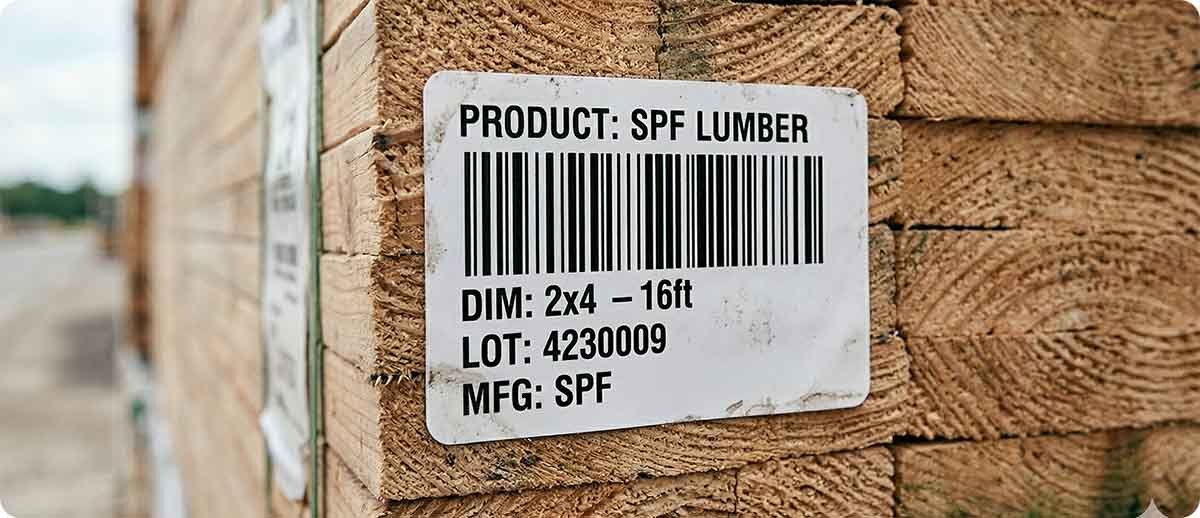
The Label Stack: Matching Media to Material and Environment
Label selection is where outdoor yard asset tracking programs most commonly fail — not because the hardware breaks, but because the label falls off, fades, or becomes unreadable before anyone notices the tracking data has gone stale. The surface being labeled, the environment it lives in, and how long it needs to survive are the three variables that determine which Zebra label material is right.
For General Outdoor Yard Labeling
Zebra Z-Ultimate 3000T Polyester Label
Up to 3 years outdoors | Enhanced adhesive for curved and textured surfaces | UL/cUL indoor/outdoor recognized
The Z-Ultimate 3000T is the step up from the standard 2000T with enhanced adhesive formulated specifically for curved and textured surfaces — which is exactly the profile of rough-sawn lumber, timber bundles, and wrapped steel. The enhanced adhesive provides better initial tack and long-term bond strength on irregular surfaces that defeat standard flat-surface adhesives. Up to 3 years outdoor performance with strong resistance to smearing, scratching, and moderate chemical exposure. UL/cUL recognized for indoor and outdoor use with compatible Zebra resin ribbons. The general-purpose outdoor polyester label for both lumber and steel yard asset tracking.
Browse Z-Ultimate 3000T →For Chemical-Exposed or Long-Life Applications
Zebra Z-Ultimate 4000T Polyester Label
Superior chemical resistance | Harshest environment rating in the Z-Ultimate range | UL/cUL indoor/outdoor recognized
The Z-Ultimate 4000T delivers the strongest chemical resistance in the Z-Ultimate family — right for steel service center labels that will be exposed to cutting oils, coolants, rust inhibitors, and cleaning solvents as part of normal processing operations. Also the right choice for pressure-treated lumber where preservative chemicals can degrade standard adhesives. Superior resistance to abrasion, chemicals, and harsh weather. UL/cUL indoor/outdoor recognized with compatible Zebra resin ribbons. When the 3000T's performance isn't enough for particularly aggressive chemical environments, the 4000T is the specification step up.
Browse Z-Ultimate 4000T →For Matte Surface Finish or High-Glare Outdoor Environments
Zebra Z-Xtreme 4000T Matte Polyester Label
Up to 2 years outdoors | Matte finish reduces glare for outdoor scanning | High-tack adhesive | UL/cUL indoor/outdoor recognized
Where the Z-Ultimate series uses a gloss finish, the Z-Xtreme 4000T uses a matte finish that reduces glare — a meaningful advantage when scanning labels in direct sunlight where gloss surfaces can create optical interference. High-tack adhesive for strong initial bond on rough or low-energy surfaces. Strong chemical resistance and UV performance for outdoor applications. Up to 2 years outdoors. Right for operations where direct sun scanning is routine and glare from gloss labels causes scanner read failures.
Shop Z-Xtreme 4000T →Label Placement Strategy: Where to Tag in a Yard Operation
Even the right label fails if it's placed where it can't be scanned or won't stay adhered. Outdoor yard asset tracking requires a placement strategy built around how product is actually handled and scanned — not where it's convenient to apply a label at receiving.
Lumber bundles: Apply labels to the ends of bundles, not the sides. Bundle sides contact strapping, forks, and adjacent stacks — any of these interactions peel a label applied to the face of a bundle. The end of a bundle is protected during forklift handling and visible for scanning from the aisle. Use a label size large enough to be readable with a DS3678-XR from forklift cab distance — a 4x2" or 4x3" label is typically the minimum practical size for aisle-level scanning.
Individual boards and dimensional lumber: End-tagging with a label or hang tag is standard practice. For high-volume operations, inkjet or thermal inkjet marking directly on the end grain is common at the mill level — but for distribution yard tracking where labels are applied at receiving, end-applied polyester labels with Z-Ultimate 3000T adhesive hold well on planed end grain surfaces.
Steel bar, structural shapes, and pipe: End-tagging works for cut lengths. For coils and full-length rod or bar, labels go on the identification tag attached to the bundle tie — not directly on the metal surface at the body of the product. Where direct metal surface labeling is required, Z-Ultimate 4000T with high-tack adhesive on clean, oil-free metal is the correct specification. Always clean the metal surface with IPA before label application — mill oil is the single most common cause of label failure on steel.
Plate and sheet steel: Edge labeling or label applied to protective paperboard interleaving is preferred over direct metal surface application wherever the interleaving is maintained through the distribution process. Where direct application is required on sheet or plate, Z-Ultimate 4000T or a high-tack aggressive adhesive polyester is appropriate on clean metal.
Fixed location markers (rack and bay identification): Outdoor metal racking requires label materials rated for sustained outdoor exposure and direct UV. Z-Xtreme 4000T applied to cleaned metal rail surfaces provides durable bay and location identification that survives seasons of outdoor exposure. Position rack labels at consistent height and orientation so forklift operators can develop a repeatable aiming routine with the DS3678-XR.
Frequently Asked Questions: Yard Asset Tracking
Can we use our existing warehouse scanners in the yard?
In most cases, no — at least not reliably. Standard warehouse scanners are typically rated to 5-6 foot read ranges with red LED aimers that are invisible in direct sunlight, IP ratings suited to indoor splash conditions, and drop specs tested on clean concrete. In a lumber or steel yard, you need extended range scanning capability, aiming systems that work in bright sun, and IP68 sealing against sawdust and metallic particle intrusion. The DS3678-XR addresses all of these gaps; a standard warehouse scanner does not.
Our labels keep falling off pressure-treated lumber. What's wrong?
Almost certainly an adhesive mismatch. Pressure-treated lumber contains copper-based preservatives (CA, CCA, or ACQ depending on treatment type) and often has high residual moisture. Standard permanent acrylic adhesives lose bond strength on moist, chemically active surfaces. Z-Ultimate 3000T with its enhanced adhesive formulation is the right starting point. If failure continues, have the treated lumber surface tested for moisture content — above 19% moisture content, almost no label adhesive performs reliably, and a different attachment method (tie-on tag, staple tag) may be necessary until the lumber dries.
How do we handle scanning product that doesn't have a flat labelable surface?
For round bar, pipe, and other non-flat profiles, tie-on paper or polyester tags are a common solution — a tag attached to the bundle tie rather than adhesive-bonded to the product. Brady and other tag suppliers make weatherproof polyester tags designed for outdoor use on wire or cable tie attachment. For coil identification, a tag clipped to the inner diameter protective ring is standard practice. Contact our team — we can help identify the right tag format and material for your specific product profile.
Our forklift operators are scanning from the cab with a DS3678. How far should they realistically be able to scan?
With the DS3678-XR and a properly sized label (minimum 4x2" is recommended for aisle-level forklift scanning), reliable scanning from a forklift cab at 20-40 feet is achievable under normal yard conditions. The green laser aimer is visible in direct sunlight at distances up to 10 feet, making aiming more accurate outdoors than with standard red aimers. Practical range varies based on label size, barcode density, print quality, and ambient lighting. We recommend a scanning distance test with your actual labels at your facility before finalizing label specifications.
We have Wi-Fi dead spots throughout our steel building. What can we do?
Metal structures absorb and reflect Wi-Fi signals, creating coverage challenges that require a proper wireless site survey and access point placement strategy — not just adding more access points. Zebra's Wi-Fi 6E on devices like the MC9400 helps at the device end by taking advantage of less-congested spectrum, but the infrastructure side matters equally. Contact our team for a wireless assessment — solving connectivity in a metal-structure environment is a solved problem with the right network design, and we can help guide you through it.