
Fixed Mount Scanners vs. Handheld: When Automating a Scan Point Makes More Financial Sense
Posted by Midwest Barcoding Solutions on Sep 14th 2026

By Midwest Barcoding Solutions | Fixed Mount Scanners | Automation Decision Guide
Fixed mount scanners are one of the most under-evaluated categories in barcode hardware. Most operations default to handheld scanners because that's what they know, and the question of whether a fixed mount would serve the same scan point better and at lower cost per scan event doesn't get asked until someone is looking at labor costs or throughput bottlenecks and starts wondering why a person is still standing at a specific point doing nothing but scanning.
What a Fixed Mount Scanner Actually Is
How does a fixed mount scanner differ from a handheld?
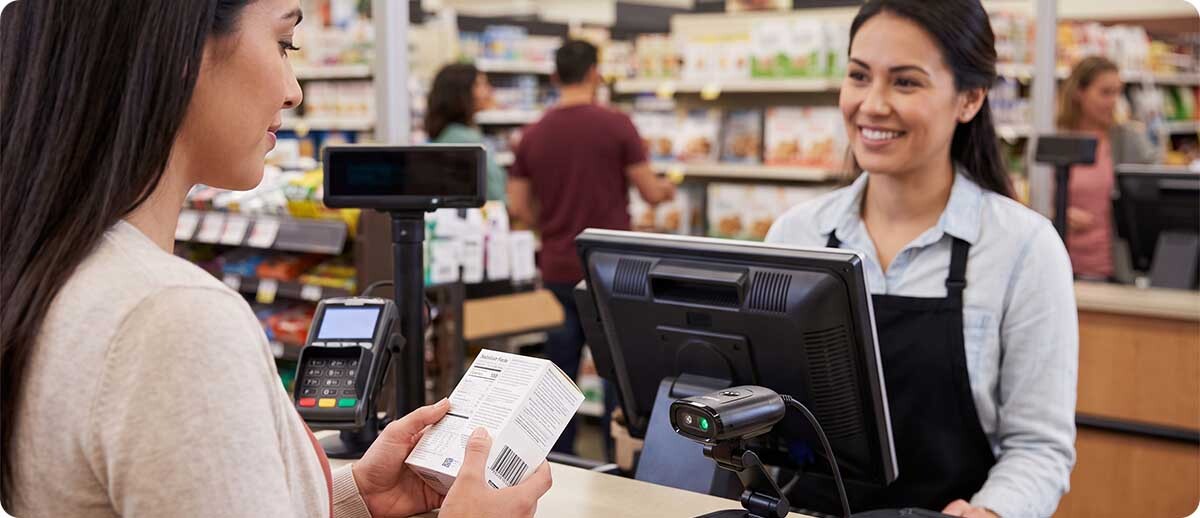
A fixed mount scanner is permanently installed at a scan point, mounted to a surface, bracket, conveyor frame, kiosk housing, or counter, and scans automatically when an item passes through its field of view or when a person presents an item to the scanner. There is no worker holding the scanner, no trigger to pull, and no human in the loop for the scan event itself. The scan just happens as part of the workflow.
Fixed mount scanners connect to host systems via USB, RS-232, or Ethernet depending on the model and the integration requirement. They communicate scan data to the same WMS, POS, or processing systems a handheld would, just without a person operating them. Most current fixed mount scanners are omni-directional imagers that read barcodes presented from multiple angles without requiring precise positioning, which is what makes them practical for self-service and automated environments.
When Fixed Mount Makes Financial Sense
What scan point scenarios favor a fixed mount scanner over a handheld?
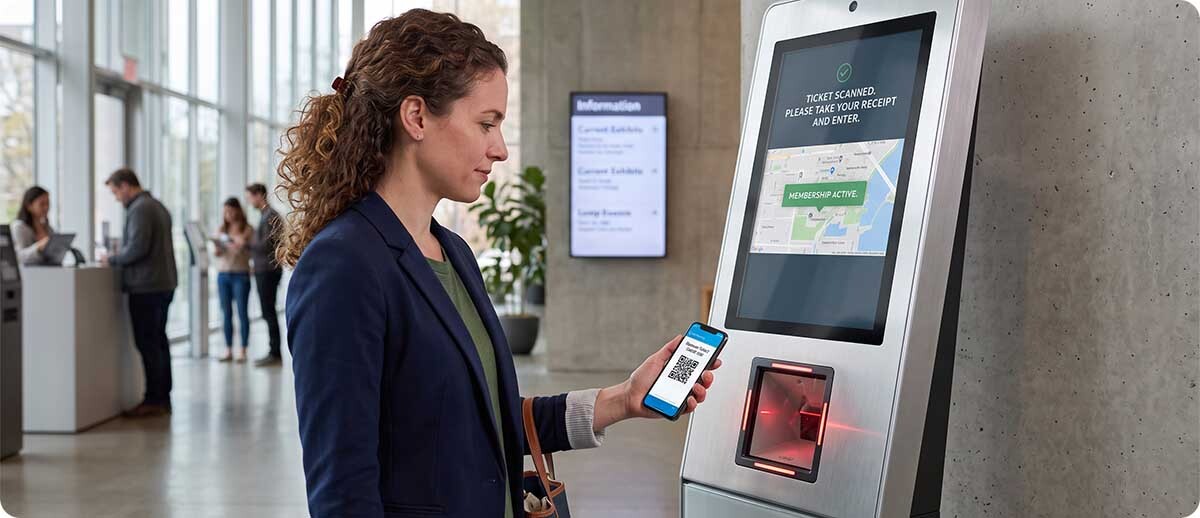
Unattended or self-service scan points. If a scan point needs to operate without a dedicated worker present, a handheld isn't an option at all. Self-service kiosks, contactless pickup lockers, loyalty program check-in stations, ticketing gates, and airport boarding gates all require a scanner that operates without someone holding it. This is the clearest fixed mount application because it's not a cost comparison, it's a capability requirement. A fixed mount scanner is the only tool that works.
High-volume attended scan points where the scan is the only task. When a worker's entire job at a specific station is to scan items as they pass through, and they're doing nothing else between scans, the question becomes whether a fixed mount could handle the same throughput without the labor cost. In a receiving operation where a worker stands at a conveyor and scans every incoming package, a fixed mount scanner on the conveyor does the same job automatically at a fraction of the per-scan cost over the life of the installation. The hardware cost is paid off in labor hours saved relatively quickly at volume.
Scan points that require consistent positioning. Fixed mount scanners produce more consistent scan results than handheld scanners operated by multiple workers because the scan angle, distance, and illumination are constant. In applications where barcode orientation matters or where inconsistent scan technique causes scan failures that require rescans, a fixed mount eliminates the human variable entirely.
Integration into automated systems. Conveyor lines, automated sortation, manufacturing quality checkpoints, and PLC-controlled production lines all benefit from fixed mount scanners because they can be wired directly into the automation controller and trigger scan events programmatically rather than requiring a human operator at each scan point. Adding a handheld scanner to an automated system is a workaround. A fixed mount scanner is the right integration.
When does a handheld scanner still make more sense?
When the worker moves between scan points, when the scan volume at any single point is low enough that dedicated hardware isn't justified, or when the scan requirement is ad hoc rather than at a predictable fixed location. A worker who scans in six different locations during a shift needs a handheld. A worker whose entire shift is scanning items at one location is a candidate for a fixed mount replacement of the scan task.
The Fixed Mount Scanners at MBS
Zebra DS55: retail counters, kiosks, and contactless environments
The Zebra DS55 is a compact fixed mount scanner designed for retail, self-service, and embedded applications. Its small footprint fits into kiosk housings, counter installations, and embedded product designs where space is limited. It handles 1D and 2D barcodes including mobile phone screen barcodes for loyalty programs, ticket verification, and digital coupon redemption. The DS55 is the right scanner for attended retail counters where the cashier presents items to the scanner rather than scanning with a handheld, for self-service kiosks where customers scan their own items or tickets, and for contactless pickup lockers where the customer presents a barcode to retrieve their order.
Zebra DS55 Fixed Mount Scanner
1D/2D | Compact footprint | Standalone and embedded | Retail, kiosk, self-service, ticketing, contactless pickup
Shop Zebra DS55 →Honeywell Vuquest 3320g: light industrial and presentation scanning
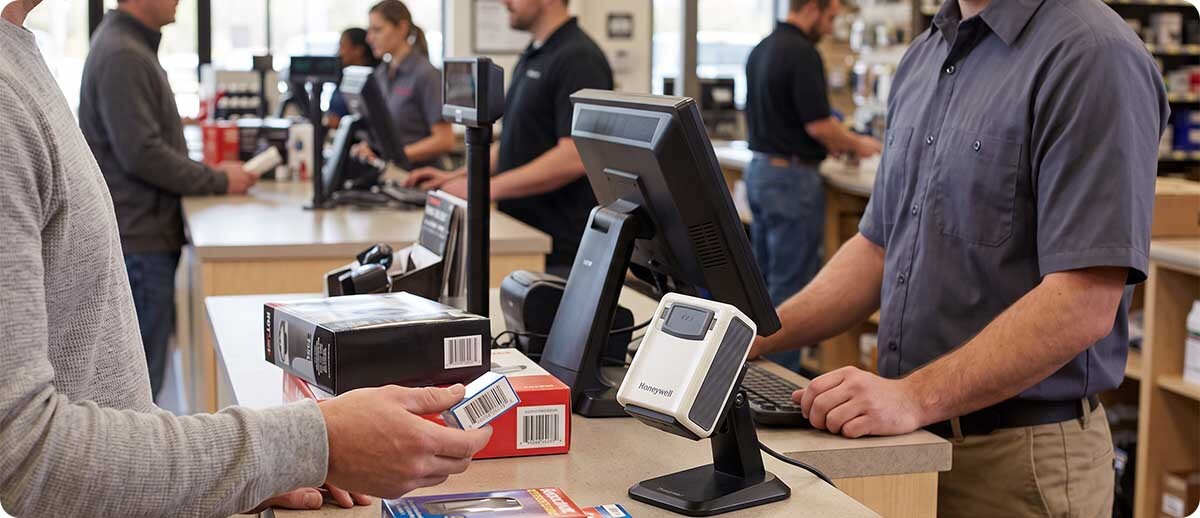
The Honeywell Vuquest 3320g is a handheld scanner that also functions as a fixed mount scanner through its universal mounting system and presentation mode scan performance. In presentation mode it scans automatically when a barcode enters its field of view without requiring a trigger, which makes it suitable for attended counter environments and light industrial scan points where a dedicated fixed mount isn't required but hands-free operation is preferred. It reads 1D, 2D, and PDF barcodes including barcodes on mobile phone screens, and its Cortex Decoder technology handles shiny and hard-to-read surfaces that trip up standard scanners.
Honeywell Vuquest 3320g
1D/2D/PDF | Universal mounting | Presentation mode | Mobile phone screen reading | Light industrial and counter applications
3320G-4-N: Scanner only
3320GHD-4-N: High density scanner only
3320G-4USB-0-N: USB kit
Shop Honeywell Vuquest 3320g →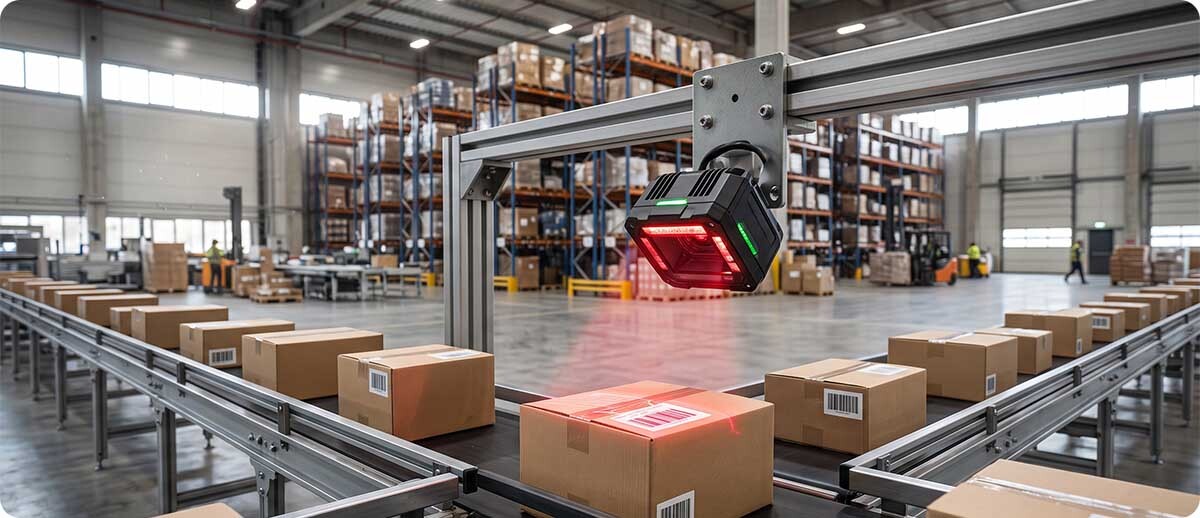
The Quick Decision Framework
| Your Scan Point Situation | Right Tool |
|---|---|
| Worker moves between multiple scan points during a shift | Handheld |
| Scan point needs to operate without a worker present | Fixed mount |
| Worker stationed at one point scanning items all shift | Evaluate fixed mount ROI |
| Kiosk, self-service, or embedded product integration | Fixed mount |
| Conveyor or automated production line scan point | Fixed mount |
| Attended retail counter, customer presents item to scanner | Fixed mount (DS55) |
| Low-volume ad hoc scanning at unpredictable locations | Handheld |
Questions We Get on This
How do we calculate whether a fixed mount scanner pays off vs. keeping a worker scanning?
Start with the hourly labor cost at the scan point including wages and benefits. Multiply by the hours per day the scan point operates and then by the number of working days per year. That's the annual labor cost of a human at that scan point. Compare it to the hardware cost of a fixed mount installation including the scanner, mounting hardware, and integration. In most operations where a worker is dedicated to a single scan point for a significant portion of their shift, the fixed mount pays off in labor savings within one to two years and then operates at essentially zero marginal cost per scan event for the remaining hardware lifespan.
Can a fixed mount scanner read barcodes from any angle or does the item need to be positioned precisely?
Modern fixed mount imagers like the DS55 uses omnidirectional imaging that reads barcodes regardless of orientation, which means items don't need to be precisely positioned. The barcode just needs to pass through the scan zone at a reasonable distance and angle. For conveyor applications, the scanner can be positioned to cover the full width of the belt and read barcodes on packages regardless of which face of the package the barcode is on, as long as the barcode faces the scan zone at some point during the pass.
If you have a specific scan point you're evaluating for a fixed mount installation and want help with the scanner selection, integration requirements, or the ROI calculation, fill out the form below. We can usually get to a clear recommendation quickly once we understand the scan environment and volume.