
What Is a UHF RFID Reader and When Does Your Operation Actually Need One?
Posted by Midwest Barcoding Solutions on Oct 12th 2026
By Midwest Barcoding Solutions | RFID | UHF RFID Readers Explained
This is a straightforward explanation of what UHF RFID readers are, how they differ from barcode scanning, what the main reader types do, and the honest answer to when an operation actually needs one versus when barcode scanning is still the right call.
What Is a UHF RFID Reader?
How is RFID different from a barcode scanner?
A barcode scanner reads a printed symbol using light. It requires line-of-sight to the label, one scan per item, and a label that's clean, undamaged, and oriented correctly toward the scanner. That works well for most operations, and barcode scanning remains the right technology for the vast majority of warehouse and distribution workflows.
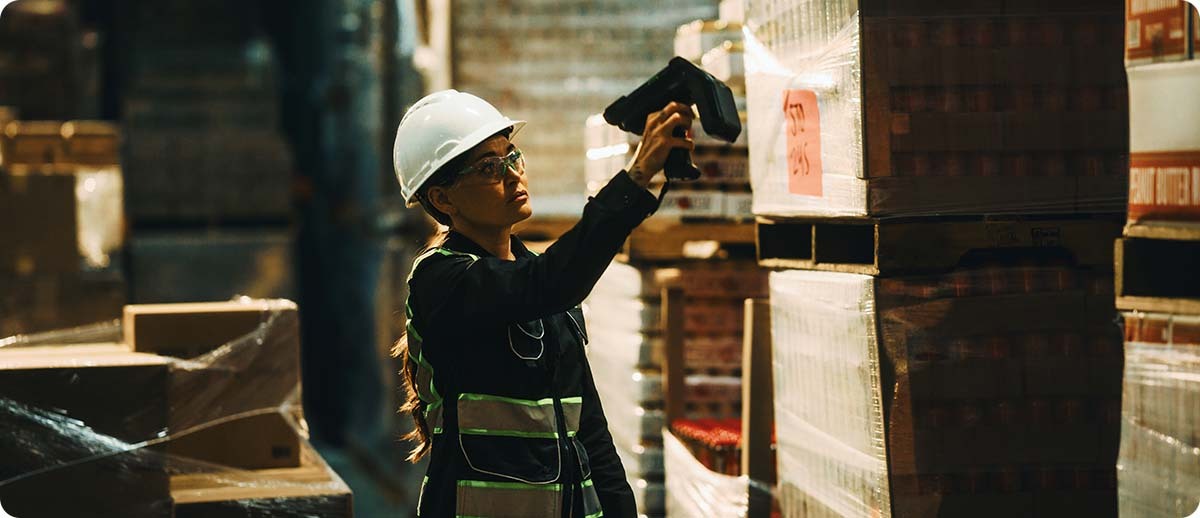
A UHF RFID reader works differently. It broadcasts radio frequency energy that powers passive RFID tags in its field, receives the signal those tags reflect back, and decodes the unique ID stored on each tag's chip. No line-of-sight required. No one-at-a-time constraint. A reader positioned at a dock door can capture every tagged item on a pallet as it passes through, all in a fraction of a second, without a worker touching a scanner or positioning a label.
That difference in how data is captured is what makes RFID valuable in specific contexts and unnecessary in others. The technology isn't better than barcodes universally. It's better at specific things that barcodes handle poorly.
What does UHF mean and why does it matter?
RFID operates across several frequency ranges. High-frequency (HF) RFID, at 13.56 MHz, is what your access badge and contactless credit card use. It reads at very short range, typically a few centimeters, and is used for secure identification where intentional, close-proximity reads are the point.
Ultra-high frequency (UHF) RFID operates in the 860 to 960 MHz range and is the frequency used in supply chain, warehouse, retail, and asset tracking applications. UHF tags can be read from several feet to over 20 feet away depending on the reader, antenna, and tag placement. They're also inexpensive enough to apply to individual items at scale, with passive UHF tags available for a few cents each in volume. When people talk about RFID in a warehouse or distribution context, they're almost always talking about UHF RFID.

Types of UHF RFID Readers
What are the different kinds of RFID readers and what does each one do?
There are four main reader types used in warehouse and industrial environments. Each serves a different use case:
Fixed RFID Readers
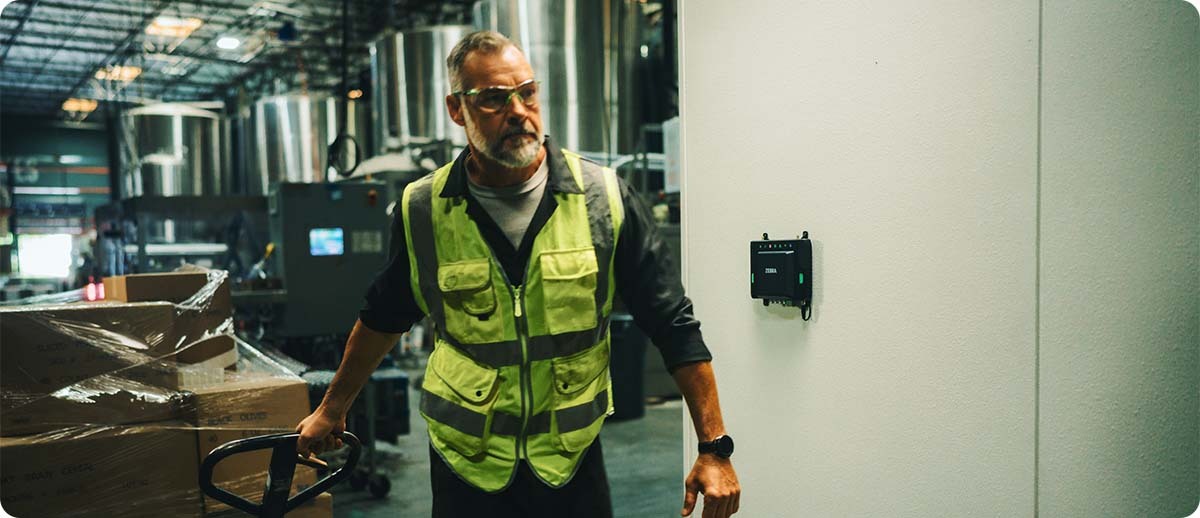
Permanently mounted devices, usually at chokepoints like dock doors, conveyor entry and exit points, or room entry zones. They read every tagged item that passes through their antenna field without any worker involvement. A fixed reader at a receiving dock can log an entire incoming pallet in seconds as the forklift moves through. Fixed readers are the foundation of automated RFID workflows where the goal is capturing inventory movement data without manual scanning.
Handheld RFID Readers
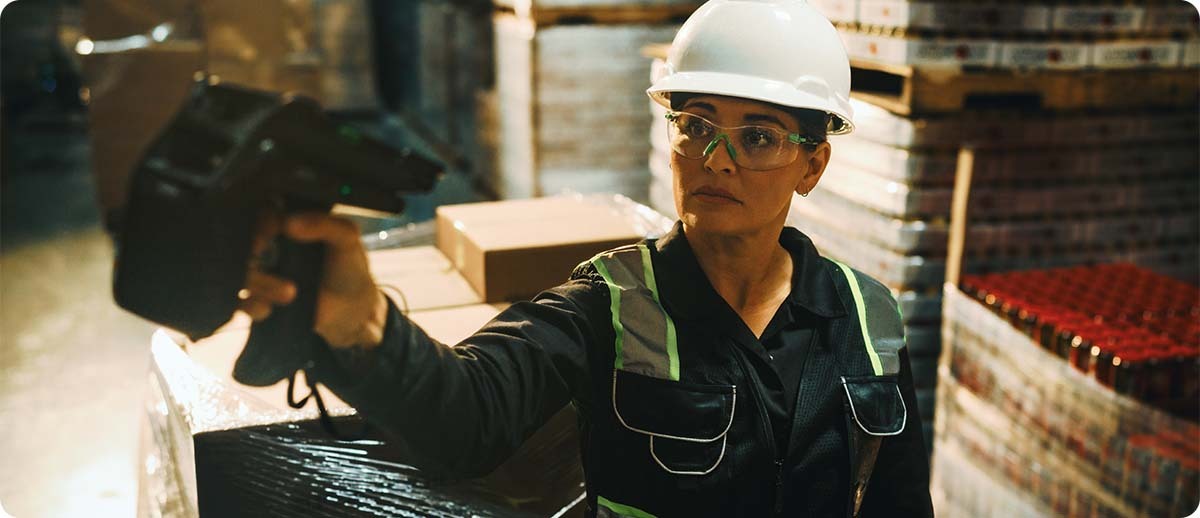
Portable readers that workers carry through a space, reading tagged items in the surrounding area as they walk. A worker doing a cycle count in a retail stockroom or a warehouse aisle can read hundreds of tagged items by walking the space rather than scanning each one individually. Handheld readers are the right tool when the read point needs to move with the worker rather than being fixed at a specific location.
RFID Sleds
Attachments that add UHF RFID reading capability to an existing mobile computer. A worker's Zebra TC-series mobile computer connects to an RFID sled and gains RFID read capability without replacing the mobile computer entirely. Sleds are a cost-effective path to RFID when the mobile computer fleet is current and the goal is adding RFID capability to a workflow without a full hardware replacement cycle.
RFID-Enabled Mobile Computers
Mobile computers with UHF RFID reading built into the device itself, combining standard barcode scanning and RFID reading in a single unit. Workers can switch between barcode and RFID workflows on the same device. This is the cleanest option for operations that need both capabilities in a single handheld without managing two separate devices or a sled attachment.
When Does Your Operation Actually Need RFID?
What problems does RFID solve that barcodes can't?
RFID earns its cost when one or more of these conditions exist in your operation:
High-volume receiving or shipping where individual scans are the bottleneck. If your dock workers are spending meaningful time scanning each item individually on a large incoming shipment, fixed RFID at the dock door reads the entire pallet in a pass. The labor saved at scale on high-volume receiving operations is where RFID delivers its clearest ROI.
Inventory counts that take too long or happen too infrequently. Physical inventory counts with barcode scanners are slow enough that most operations do them quarterly or annually. RFID handheld readers cut cycle count time dramatically — a worker walking an aisle reads hundreds of tags without stopping to present each label to a scanner. Operations that need more frequent, faster inventory accuracy checks use RFID to make cycle counting practical on a daily or weekly basis.
Items that can't be easily positioned for barcode scanning. Irregular shapes, items in bags or boxes where the label isn't consistently accessible, items moving on a conveyor in random orientations — these create scan failures and workarounds with barcodes. RFID doesn't care about label orientation. If the tag is in the read field, it gets read.
Asset tracking where items leave and return to the facility. Tracking reusable assets like totes, pallets, carts, tools, or equipment across a facility or between locations is difficult with barcodes because it requires someone to actively scan the item at each movement. Fixed RFID readers at exit and entry points capture every movement automatically without worker involvement, giving you a real-time location picture without manual scan discipline.
Retailer or trading partner mandates. Major retailers including Walmart, Target, and others have RFID compliance requirements for suppliers. If a customer is requiring RFID-encoded labels on shipments, the choice isn't whether to implement RFID but how to implement it efficiently with the right printer and encoding setup.
When should you stick with barcodes?
Most operations. Barcodes are cheaper to implement, simpler to maintain, and sufficient for the vast majority of warehouse, distribution, manufacturing, and retail workflows. If your current barcode scanning operation is running smoothly and your scan volume per worker per shift is manageable, RFID doesn't solve a problem you have.
RFID adds cost at every layer: tags cost more than barcode labels, readers cost more than barcode scanners, implementation requires more planning, and the system requires ongoing management. That cost is worth it when RFID eliminates a real bottleneck or unlocks a workflow that barcodes genuinely can't support. It's not worth it when the operation is fundamentally a scan-one-at-a-time workflow that barcodes handle fine.
There are also environments where RFID performs poorly regardless of reader quality. Dense metal environments interfere with UHF signals because metal reflects radio waves and can create dead zones. Liquids absorb UHF energy and reduce read range significantly. Items with high metal or liquid content, like canned goods or metal parts in bins, require specific tag placement and reader positioning to work reliably. This doesn't make RFID impossible in those environments, but it does require more careful engineering than a standard deployment.
Quick Questions
Can a UHF RFID reader also scan barcodes?
Dedicated RFID readers typically do not scan barcodes — they're built specifically for RFID. RFID-enabled mobile computers and some combination devices handle both, which is why they're popular in operations that run mixed workflows. If your operation needs both barcode scanning and RFID reading from a single worker-carried device, an RFID-enabled mobile computer or a sled attached to your existing mobile computer is the right approach rather than carrying two separate devices.
How far away can a UHF RFID reader read a tag?
Read range depends on the reader's power output, the antenna configuration, and the tag itself. In a controlled environment with a standard passive UHF tag, a quality fixed reader with a directional antenna can read reliably at 20 to 30 feet. Handheld readers typically operate at shorter effective ranges, from a few feet to around 20 feet depending on the reader. Environmental factors, including nearby metal and RF interference from other equipment, affect real-world range. In dense metal environments, practical read range is often significantly shorter than the reader's rated maximum.
Do we need to replace all our barcode labels with RFID tags to use RFID?
Not necessarily. Many RFID implementations are additive rather than replacement. RFID tags are applied to specific items, assets, or locations where RFID provides value, while the rest of the operation continues using barcodes. It's also common to use RFID-enabled labels that carry both a human-readable barcode and an embedded RFID inlay, so a single label supports both reading methods. An RFID printer encodes the inlay while printing the barcode label in a single pass, which simplifies the label application workflow.
If you're evaluating whether RFID makes sense for a specific workflow in your operation, the easiest starting point is a conversation about what problem you're actually trying to solve. Most of the time we can tell you in a few questions whether RFID is the right answer or whether there's a barcode-based solution that gets you there without the RFID investment. Reach out to the Midwest Barcoding Solutions team and we'll help you figure it out.